Last updated: November 01, 2026
Quick Answer: medication safety and dosing is usually about checking one dose against four details — the active ingredient, the strength, the route, and the schedule — before the next dose. Medication safety and dosing: the complete guide is most useful when the label is clear, but it becomes even more important when the medicine is new, the product is liquid, or more than one medicine is involved. The safest answer for your own situation is often to follow the label and confirm anything uncertain with a qualified clinician or pharmacist, especially if you take more than one medicine, have kidney or liver disease, are pregnant, or are caring for a child or older adult.
Key Takeaways
- Match the medicine’s form, strength, and schedule to the person taking it.
- Check the active ingredient, strength, route, schedule, and warnings in that order.
- Use the measuring tool marked in the product’s units and easy to read clearly.
- Most dosing mistakes come from everyday misunderstandings, not dramatic events.
The practical problem is not just “too much” or “too little.” Dosing errors also come from the wrong formulation, the wrong measuring tool, missed timing, duplicate ingredients, and assumptions like “this pill is the same as that one.” A generic article usually stops at “read the label.” That is not enough when a teaspoon is being confused with a milliliter, or when two cold products quietly contain the same active ingredient.
This guide on medication safety and dosing: the complete guide focuses on the decisions that keep people out of trouble: what dosing really means, where mistakes happen, how to read labels without guessing, when to double-check, and when the safer move is to pause and ask a professional. It also gives practical checkpoints you can use before the next dose.
What medication dosing actually means
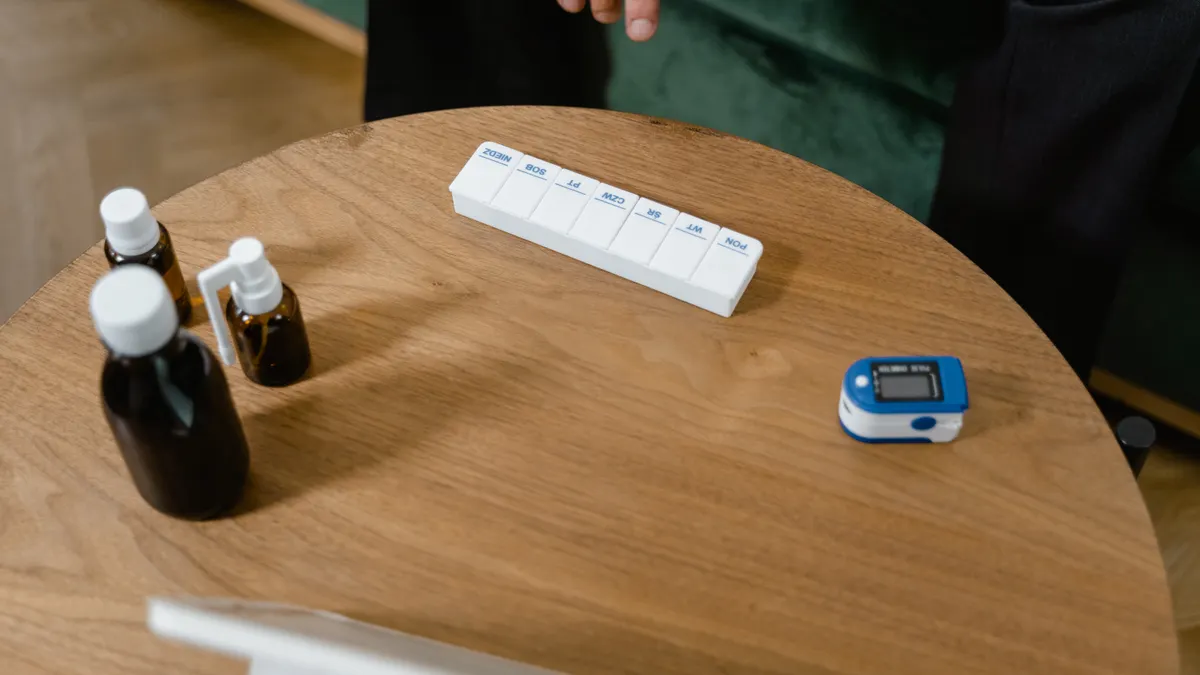
Medication dosing means matching a medicine’s form, strength, and schedule to the person taking it. That sounds obvious until the details get messy. A tablet marked 10 mg, a liquid labeled 5 mg per 5 mL, and a patch released over 72 hours are not interchangeable, even if they all seem to be the “same medicine.”
That distinction matters because the dose is not just a number. It is a package of variables: the active ingredient, the strength, the route, the frequency, and the duration. A medicine taken by mouth can behave differently from the same drug given by injection or inhalation. The label may also distinguish between immediate-release and extended-release versions, and that difference can change how quickly the drug enters the body.
Because of that, the safest habit is to read the full name, not just the brand name. Many dosing mistakes start when one product is mistaken for another product with a similar name or the same active ingredient. That is especially risky with combination products, where one tablet can contain several ingredients at once. A cold remedy, for example, may include a pain reliever plus a decongestant, so adding another product with the same pain reliever can create duplicate exposure.
PubMed records from 2016–2026 show that this subject is heavily studied, and the search results are broad enough to support a full review of dosing questions. That mix is a clue: this is a field where dosing questions are studied constantly, but the answer for an individual still depends on the medicine, the person, and the clinical context.
How do I read a medication label without guessing?
You read a medication label by checking the active ingredient, the strength, the route, the schedule, and the warnings in that order. That is the shortest reliable method, and it catches more errors than staring at the brand name alone.
Start with the active ingredient. It tells you what the medicine actually is. Then look at the strength, which might be listed as milligrams per tablet, milligrams per milliliter, or another unit. If it is a liquid, the concentration matters as much as the name. A bottle with 160 mg per 5 mL is not the same as one with 80 mg per 5 mL, even when the medicine is identical.
Next, check the route. Oral tablets, oral liquids, eye drops, ear drops, inhalers, patches, topical creams, and injections are not meant to be used the same way. A topical product should not be swallowed. An eye drop should not be used in the ear unless a clinician has specifically directed that. The route is one of the easiest places to make a harmful assumption.
Then look for the schedule. Some labels specify “every 6 hours,” others “once daily,” others “as needed.” The word “as needed” still has boundaries. Many products also have maximum daily amounts or minimum intervals between doses. If the label is unclear, it is better to verify the directions than to infer them.
Finally, scan the warnings and the inactive ingredients if allergies or sensitivities matter. The warnings may include age limits, food interactions, alcohol cautions, or signs that need medical attention. For people with a history of medication reactions, the inactive ingredients can matter too.
Two authoritative sources are especially useful here: the U.S. Food and Drug Administration’s medication guide pages and the National Library of Medicine’s DailyMed drug label database. Those are the kinds of references that help when the packaging is crowded, damaged, or hard to read.
Which dosing tools are safest?

The safest dosing tool is the one that measures in the units listed on the product and lets the user see the amount clearly. For liquid medicines, that usually means an oral syringe or a properly marked dosing cup, not a kitchen spoon.
Kitchen spoons are a bad shortcut because they are not standardized. A teaspoon from a silverware drawer is not the same thing as a dosing teaspoon on a medicine label. That difference sounds small, but it can turn into an underdose or overdose when repeated over several doses. For medicines measured in milliliters, a milliliter-marked device is the clearest option.
Oral syringes are often the best choice when a precise small volume is needed, especially for children, older adults, or anyone who struggles to pour accurately. They are also useful when the dose is small enough that a cup is hard to read. The trade-off is usability: some people find syringes fiddly, especially in low light or when a child is moving.
Dosing cups are easier for some caregivers to handle, but they are more error-prone if the liquid is thick, if the user fills past the line, or if the amount is small. A bottle cap should not be assumed to be a dose-measuring device unless the label specifically says so.
Pills bring a different problem: splitting. Some tablets are scored and intended to be split, but many are not. Extended-release and enteric-coated products are common examples where splitting can change how the drug is released. If the label does not clearly allow splitting, the safer assumption is that the tablet is meant to be taken whole unless a pharmacist says otherwise.
The big decision here is simple: choose the tool that matches the product’s units and the person’s ability to use it correctly. If dexterity, vision, memory, or language creates friction, the tool that looks convenient on the shelf may be the least safe in real life.
The real causes of dosing mistakes
The real causes of dosing mistakes are usually not dramatic. They are ordinary distractions, duplicate ingredients, and small misunderstandings that build into a larger error.
One common problem is double-dosing the same active ingredient under different brand names. This happens a lot with pain relievers, fever reducers, allergy medicines, sleep aids, and cold products. The package may look different, but the active ingredient can be the same. If a person adds “just one more” product without checking the ingredient list, the total dose can climb faster than expected.
Another common problem is unit confusion. Milligrams, milliliters, micrograms, and drops are not interchangeable. A liquid medicine should be measured in the units printed on the label, not translated mentally into a kitchen measure. A dose written in mg may require a volume calculation from the concentration on the bottle. That is where pharmacist review is especially useful.
Timing errors matter too. Some medicines are forgiving if taken later than planned; others are not. A medication meant to be spaced at regular intervals can become less safe if the timing compresses. On the other side, “missed dose” instructions differ by product. Some labels advise taking the dose soon after remembering; others say to skip it if it is close to the next dose. Those instructions are product-specific, not universal.
Storage and measurement errors also matter. Liquid suspensions may need shaking; others do not. Some products degrade with heat, moisture, or light. A medicine stored in the bathroom cabinet may survive for a while, but that is not the same as being stored correctly.
The strongest protection is to slow down at the handoff points: when starting a new medicine, switching brands, changing a formulation, or adding an over-the-counter product. Those are the moments when assumptions break.
When medication safety depends on the person, not just the product
Medication safety depends on the person whenever age, weight, organ function, pregnancy, breastfeeding, or multiple medicines change how the body handles a drug. In those situations, a label alone is not enough to make a safe decision.
Children are a classic example. Pediatric dosing often depends on weight, age, and the specific product formulation. A liquid concentration that works for one child may not be appropriate for another, even if the active ingredient is identical. That is why a pediatric dose should be verified with a clinician or pharmacist rather than guessed from an adult pattern.
Older adults face different issues. They are more likely to take several medications at once, which raises the risk of duplicate therapy, drug interactions, and confusion between similar labels. Swallowing difficulty, vision changes, and memory issues can also make dosing errors more likely. In this setting, a blister pack, a medication list, or a pharmacy-prepared schedule can help, but none of them replaces professional review.
Kidney and liver disease can change how long a medicine stays in the body. That can affect dose selection, timing, and whether a medicine is appropriate at all. The same is true for certain heart, lung, and neurologic conditions, where a drug’s side effects may matter more than its main effect. Pregnancy and breastfeeding also require extra caution because some medicines have specific risks or are handled differently during these periods.
This is the section where a generic article often becomes dangerous by omission. It may speak as if dosing is a one-size-fits-all process. It is not. A dose that is routine for one adult may be wrong for someone with reduced kidney function, a newborn, or a patient taking interacting medicines.
If any of those factors apply, the better move is not to improvise around the label. It is to ask a qualified professional to interpret the label in light of the person taking the medicine.
The honest side-by-side: prescription directions vs. over-the-counter labels in medication safety and dosing
Prescription directions win when the medicine is individualized; over-the-counter labels win when the medicine is simple and the user fits the self-care instructions. The right choice depends on how much clinical judgment the dose requires.
| Criteria | Prescription directions | Over-the-counter label | Winner for this condition |
|---|---|---|---|
| Individualization | Can reflect diagnosis, lab values, age, and other medicines | Usually written for broad self-care use | Prescription, when the situation is medically complex |
| Clarity of use | May be precise but sometimes abbreviated or handwritten in older systems | Usually printed in plain language on the package | Over-the-counter, when the user needs straightforward instructions |
| Risk of duplicate ingredients | Can still occur, especially with combination prescriptions | Common with cold, cough, allergy, and pain products | Prescription, if the regimen is already organized by a clinician |
| Need for professional interpretation | High in complex cases | Still important, but often lower for simple self-limited symptoms | Prescription, when dose depends on patient factors |
| Label accessibility | Varies by pharmacy system | Usually visible on the box or bottle | Over-the-counter, for quick checking at home |
| Chance of self-dosing error | Lower when directions are clear and the medicine is familiar | Higher when multiple products share the same active ingredient | Prescription, if taken exactly as written and explained |
| Need for monitoring | Often higher for long-term or higher-risk medicines | Usually lower, but not zero | Prescription, when labs or follow-up are needed |
| Who should skip it | Anyone who cannot understand or verify the directions should not self-manage alone | Anyone with warning signs, severe symptoms, or unclear ingredient overlap should not rely on the package alone | Neither, when there is uncertainty about safety |
The prescription side is stronger for people with chronic conditions, multiple medicines, or dosing that depends on lab monitoring. Its weakness is that it can still be misunderstood if the directions are abbreviated, copied incorrectly, or not explained at the pharmacy window.
The over-the-counter side is stronger for simple, short-term symptoms because the label is visible and the directions are designed for self-use. Its weakness is that people often treat it like a harmless category and forget that “over-the-counter” does not mean “risk-free.” The same active ingredient may be hiding inside several products at once.
For a reader deciding between the two, the real question is not which category is safer in the abstract. It is whether the dose can be understood and checked in the context of the whole medication list. If the answer is no, the safer option is not another product. It is a professional review.
How should I handle a missed dose or a possible overdose?
You should not guess either one; you should check the product-specific instructions or contact a qualified professional right away. That is the safest rule because missed-dose advice and overdose response vary by medicine.
For a missed dose, the first question is how close it is to the next scheduled dose. Many medications have label instructions that tell the user to take the missed dose if it is remembered soon enough, or skip it if it is nearly time for the next one. Some medicines should not be doubled to “catch up.” Others have stricter timing because of how they work or how much they can safely accumulate.
For a possible overdose, the warning signs depend on the medicine. A person may have none at first, or may develop symptoms later. If there is any concern that too much of a medicine was taken, poison control or emergency services may be appropriate depending on the product and symptoms. In the United States, Poison Control can be reached at 1-800-222-1222; other countries have their own poison center numbers.
This is one of the few places where speed matters more than perfection. If the product name, strength, or amount taken is uncertain, gather the bottle, the approximate time, and the number of tablets or milliliters involved before calling. That basic information helps a clinician or poison specialist assess the risk more quickly.
A generic article often leaves out the emotional part: people delay because they are embarrassed or unsure whether the situation “counts.” It counts if the amount taken may exceed the label, if a child got into a medicine, if two products with the same ingredient were used, or if unusual symptoms appear after dosing. Waiting for certainty can make a manageable problem harder to solve.
Exception scenarios that change the verdict
The general verdict flips in a few specific situations, and those situations are common enough to matter.
First, if the medicine is new to the person taking it and the directions are even slightly unclear, the safer move is not to continue alone. A pharmacist can often resolve the ambiguity in a minute or two, especially when the issue is formulation, timing, or duplicate ingredients.
Second, if the person is a child, pregnant, breastfeeding, older, or has kidney or liver disease, the default “follow the package” approach is too weak. These cases often need a dose or timing check that accounts for the person, not just the product.
Third, if there are multiple medicines on the list, the risk is less about one label and more about the combination. A clean-looking regimen on paper can still hide duplication, interaction risk, or a schedule that is impossible to follow reliably. That is where medication reconciliation matters more than brand familiarity.
Fourth, if a tablet is being split, crushed, opened, or mixed into food, the formulation needs a second look. Extended-release and enteric-coated products are not casual candidates for alteration, and the consequences can be serious enough to require professional guidance.
The verdict: what to do before the next dose
Choose the medication label if the product is familiar, the instructions are clear, the dose is simple, and no special patient factors apply. Choose a pharmacist, physician, or other qualified clinician if the medicine is new, the label is confusing, the person taking it is high-risk, or more than one product may contain the same active ingredient. Neither is safe if you are guessing, improvising with household spoons, or trying to make a complicated regimen work without help.
That is the cleanest rule in medication safety and dosing: the package is a starting point, not a final answer. The label tells you what the product says; a professional helps you decide whether that product and that dose make sense for that person on that day.
The most useful habit is also the simplest one: before the next dose, check the active ingredient, the strength, the units, the route, and the schedule, then ask for help if anything does not line up. A 30-second check prevents a lot more harm than a confident guess.
Drafted with AI; not yet reviewed by a person.